Numerical simulations of shock-driven, supersonic turbulence in colliding three-temperature laboratory plasmas
May 20, 2026· ,·
0 min read
,·
0 min read
Stefano Merlini
James R. Beattie
Vicente Valenzuela-Villaseca
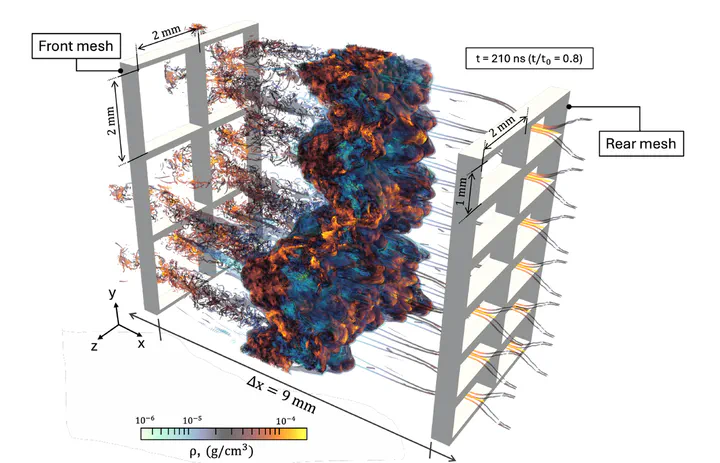 Full-domain view of the simulated double-mesh target and shocked turbulent mixing layer.
Abstract
Shock-driven turbulence is central to astrophysical plasmas where explosions and compressive driving inject energy through shocks rather than steady stirring. This study presents three-dimensional, three-temperature radiation-hydrodynamic simulations of a laboratory platform in which two offset CH mesh targets are irradiated by a 30 ns X-ray pulse. Mesh ablation launches counter-streaming supersonic flows whose vorticity is seeded baroclinically at mesh-cell corners, advected into collimated channels, and injected into outgoing streams before collision. The flows collide at about 75 ns, forming a shocked turbulent mixing layer that persists for at least 300 ns, reaches an outer scale of about 4.5 mm, and evolves toward an effectively isothermal equation of state. The velocity field relaxes toward an energy partition of roughly 70% solenoidal and 30% compressive, while the Reynolds stress remains anisotropic across much of the resolved inertial interval. These results establish the double-mesh platform as a controlled laboratory realization of sustained shock-driven turbulence and a quantitative baseline for future high-energy-density laboratory astrophysics diagnostics.
Type
Publication
Submitted to ApJ