Compressible Navier--Stokes Flow in Schrödinger-Type Variables
Apr 29, 2026· ,,,·
0 min read
,,,·
0 min read
James R. Beattie
Max Sokolova
Khush Negandhi
Bart Ripperda
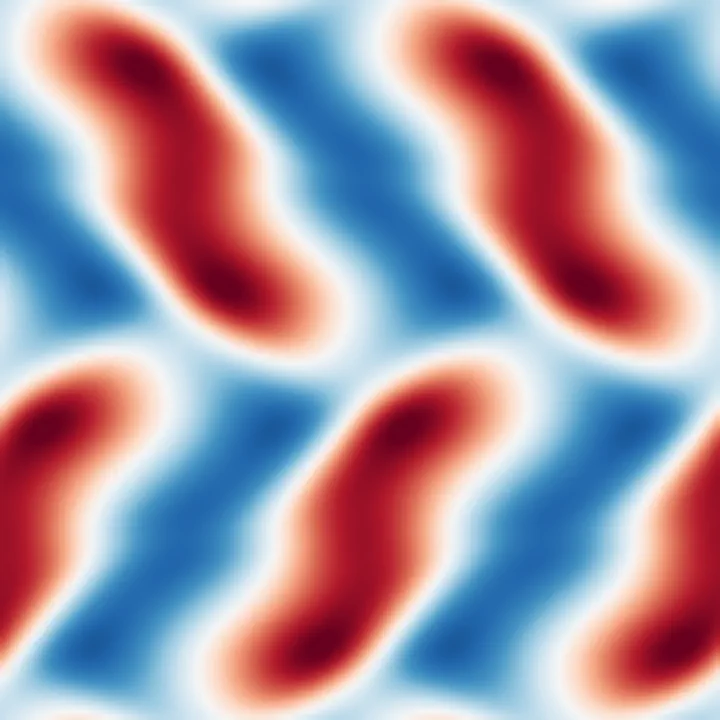 Kelvin-Helmholtz density perturbations used to validate the transformed system.
Abstract
Fluid equations are nonlinear, dissipative, and non-Hamiltonian, which makes their relation to Schrödinger evolution and quantum algorithms nontrivial. We derive an exact Eulerian Cole-Hopf-type reformulation of isothermal compressible Navier-Stokes flow in Schrödinger-type amplitude variables. In two dimensions, a Helmholtz decomposition separates the velocity into compressive and vortical potentials, whose logarithmic transforms yield two scalar imaginary-time Schrödinger-type equations with nonlinear self-consistent potentials. We show that the mixed density-compressive amplitude satisfies a nonlinear Schrödinger-type equation with a vector-potential-coupled Laplacian. The transformed system is exactly equivalent to compressible Navier-Stokes and is nonlocal only through Helmholtz and Poisson projections. In three dimensions, the density-carrying equation retains the same vector-potential-coupled structure, while the solenoidal sector admits a compressible analogue of Ohkitani’s incompressible Navier-Stokes Cole-Hopf formulation. A two-dimensional Kelvin-Helmholtz unstable shear-layer calculation verifies the transformed equations against a direct compressible Navier-Stokes simulation.
Type